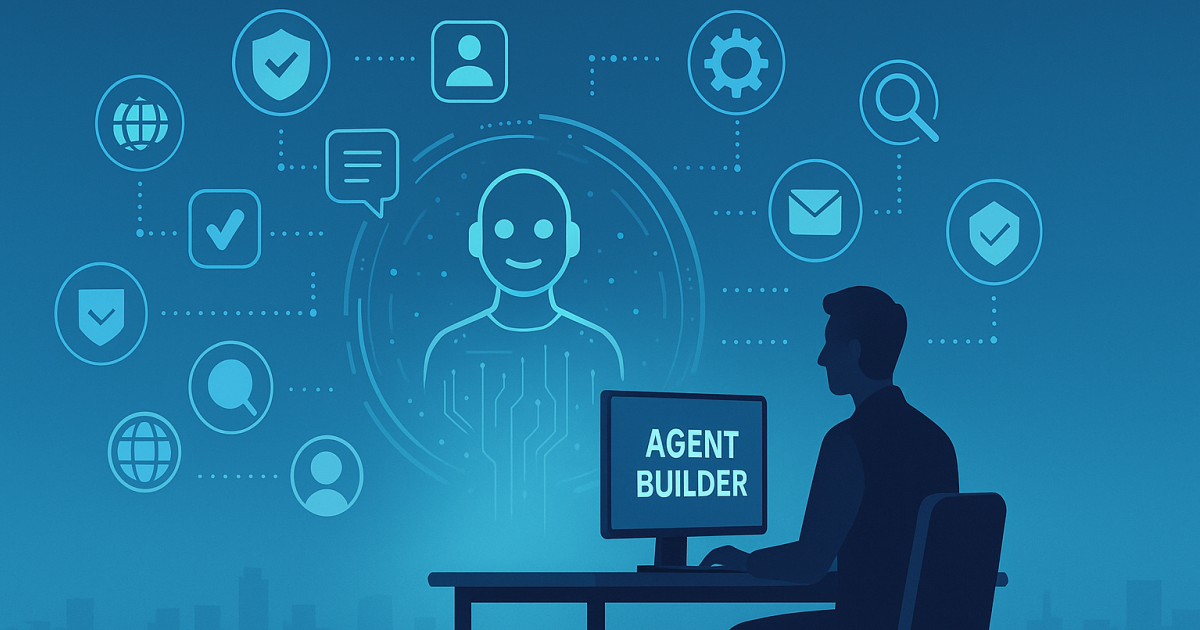
Egnyte’s announcement of its new AI Agent Builder is another sign that enterprise AI is moving from passive copilots to proactive digital coworkers. The no-code framework lets business users create secure, task-specific agents that work across a company’s internal content and the public web.
Egnyte frames the tool as a way to reduce friction between the desire to use AI and the practicality of deploying it at scale – without routing every request through an engineering queue. The release includes starter agents (Content Generator, Document Reviewer, Spanish Translator, Web Search) and a Prompt Wizard to help non-technical staff shape high-quality instructions.
The timing is certainly right. Agentic AI as the next phase of enterprise technology evolution, where AI systems don’t just answer questions but pursue goals, orchestrate tools, and take actions (ideally, with appropriate guardrails). Gartner projects that, by 2028, a third of enterprise software will include agentic AI and at least 15% of day-to-day work decisions will be made autonomously. While that leaves plenty of room for additional growth, it’s a significant uptick from negligible levels last year. IDC similarly forecasts that by the end of this year, roughly half of organizations will deploy enterprise agents tailored to specific functions. Together, these signals point to a near-term normalization of AI agents alongside traditional applications and workflow tools.
What makes Egnyte’s move notable is the emphasis on user-driven automation with enterprise controls.
"In order to effectively incorporate AI into a business's day-to-day operations, it needs to be placed in the hands of the users who know their content and workflows best," explained Amrit Jassal, Egnyte CTO and co-founder. "There is a tremendous appetite for AI implementation across the board right now, but there has been a disconnect between the desire to incorporate this technology and the practicality of it.”
The implication: productivity gains are unlocked when the people living the process can shape the automation themselves, subject to the same permissions and governance already applied to content. It makes sense, and the theory aligns with recent guidance from McKinsey, which argues organizations must re-imagine work “with agents at the core,” designing for vertically oriented use cases rather than horizontal or enterprise-wide agents.
The early use cases Egnyte highlights span finance, AEC (Architecture, Engineering, and Construction), and HR. Notably, these are all content-heavy environments. In financial services, agents can read long CIMs, extract target metrics, and draft investment memos that analysts then refine. In AEC, they can craft subcontractor RFPs and compare building-code requirements across jurisdictions. HR teams can field policy questions with answers grounded in the current handbook and benefits documents. Each example reflects a common pattern of building agent that ingest domain-specific content, apply structured prompts, and emit consistent, auditable outputs… quickly.
Across industries, similar patterns are emerging. For instance:
- Life sciences: Agents assist with SOP alignment, labeling consistency, and evidence gathering for submissions. This accelerates document reviews while preserving traceability.
- Manufacturing and supply chain: Sense-and-respond agents monitor supplier updates, weather, and logistics constraints, and propose mitigations and trigger workflows to balance inventory.
- Customer service: Agents move beyond chat to orchestrate resolution. They open tickets, check entitlements, schedule follow-ups, and escalate within rules to lift CSAT while reducing handle time.
- Legal and compliance: Review agents flag risky clauses, compare against playbooks, and generate redlines for counsel to approve, to shorten cycle times without relaxing controls.
- Marketing and sales: Research agents synthesize competitive intelligence from public sources and internal notes, tailor content to personas, and populate CRM fields with citations for verification.
To turn AI agents into an ongoing competitive advantage, businesses should focus on three design principles:
- Start with governed data and clear boundaries. Enterprise agents only earn trust when they respect permissions, log actions, and surface sources. Egnyte’s approach keeps agents inside its content and access model, which can reduce the risk of oversharing sensitive files or hallucinating unsupported claims.
- Blend templates with customization. Off-the-shelf agents accelerate time-to-value, but differentiation comes from process-specific prompts, memory, and tool integrations. McKinsey suggests that the most powerful agents are those aligned to a company’s “logic, data flows, and value creation levers,” not just generic task bots. Egnyte’s Prompt Wizard and sharable templates are tools that enable that balance.
- Redesign work, not just tasks. Agent adoption stalls when organizations simply “add AI” to existing steps. The bigger unlock is re-defining who (human or agent) does what, when, and with which tools (along with appropriate training, measurement, and governance). That cultural and operational shift is a key factor in successful AI agent adoption.
"Our Agent Builder democratizes AI-powered automation so that teams can build the exact tools they need to solve productivity challenges without needing intervention from their engineering teams," said Prasad Gune, Chief Product Officer at Egnyte. "This goes beyond simply improving processes; it represents a fundamental shift in how knowledge-based work gets done, without compromising data privacy and security."
It’s a logical approach that combines autonomy with accountability, invites the people closest to processes to shape agents. In the a broader context, this approach should create competitive differentiation.
AI agents are becoming a standard layer in the enterprise stack, alongside apps, data platforms, and collaboration tools, and vendors will keep shipping embedded agents, but competitive advantage come from businesses’ ability to compose their own agents, based on their content, context, and controls. That’s what Egnyte’s AI Agent Builder enables.
Want to go deeper on how to design, deploy, and govern agents that deliver real ROI? Check out the AI Agent Event, taking place September 29-30, 2026, in Herndon, Virginia, in the greater Washington, D.C. metro area. AI Agent Event provides a forum for practitioners to compare playbooks, see use cases in action, and learn how to put AI agents to work in their own businesses.Edited by
Erik Linask