A company launches an AI voice agent to qualify sales leads. The team tests the conversations. It tests the CRM integration. It checks that the agent follows its instructions. The project goes live.
A few weeks later, the sales team revises its qualification criteria. The agent still abides by the old rules.
Some leads are scored incorrectly. Others reach sales representatives without the information they need.
Who gives a damn? Who updates the agent? Who makes sure the changes work?
These questions often get less attention than the choice of model, voice, or agent platform. Yet, they determine whether an AI agent continues to deliver useful results after launch.
Building an agent is one job. Managing the agent in production is another.
Every Production System Must Have an Owner
Companies assign owners to applications, operations teams to production services, and managers to employees. Each role has specific responsibilities.
AI agents have similar needs. A voice agent can talk to customers, qualify leads, update records, schedule appointments, or kick off business processes. It affects customers and employees, along with the systems and data behind each interaction.
The agent must be tested to verify that it does the right things, follows current business rules, and handles exceptions correctly.
The Five Layers of Agentic Voice provides a useful architectural lens. An agent is part of a larger system that includes communications infrastructure, business systems, and business outcomes.
Managing the agent means managing those connections as well as the conversation.
A successful launch offers no guarantee of long-term performance. Business requirements change. Integrations change. Customer behavior changes. The agent and its operating rules need ongoing attention.
What Does an AI Agent Manager Do?
The role begins with a set of practical duties:
- Performance tracking: Monitor successful task completion, escalation rates, failed interactions, and business results. Much of a conversation tells you little about whether the agent is doing useful work.
- Conversation review: Examine examples and investigate unusual outcomes. Look for misinterpretations, wrong answers, repeated customer frustration, and situations where the agent follows its instructions but produces the wrong result.
- Exception handling: Define the agent’s behavior when it encounters an unknown request, an integration failure, or an action outside its permissions. Decide when the agent should retry, stop, or hand control to a human.
- Instructions and permissions: Update prompts, business rules, approved actions, and escalation conditions as requirements change. Test changes before deploying them widely.
- Verification of improvements: Confirm that a fix solves the original problem without creating another one. Monitor performance after the change.
Consider an appointment-booking agent that starts suggesting unavailable time slots after a scheduling system changes. The manager needs to identify the pattern, work with the team responsible for the integration, test the correction, and check subsequent bookings.
This work connects technical maintenance to business responsibility. It needs an owner and a consistent process.
Who Should Own the Agent?
Not every company needs a new department called Agent Operations. Existing teams often have the right skills. The important thing is to define responsibilities.
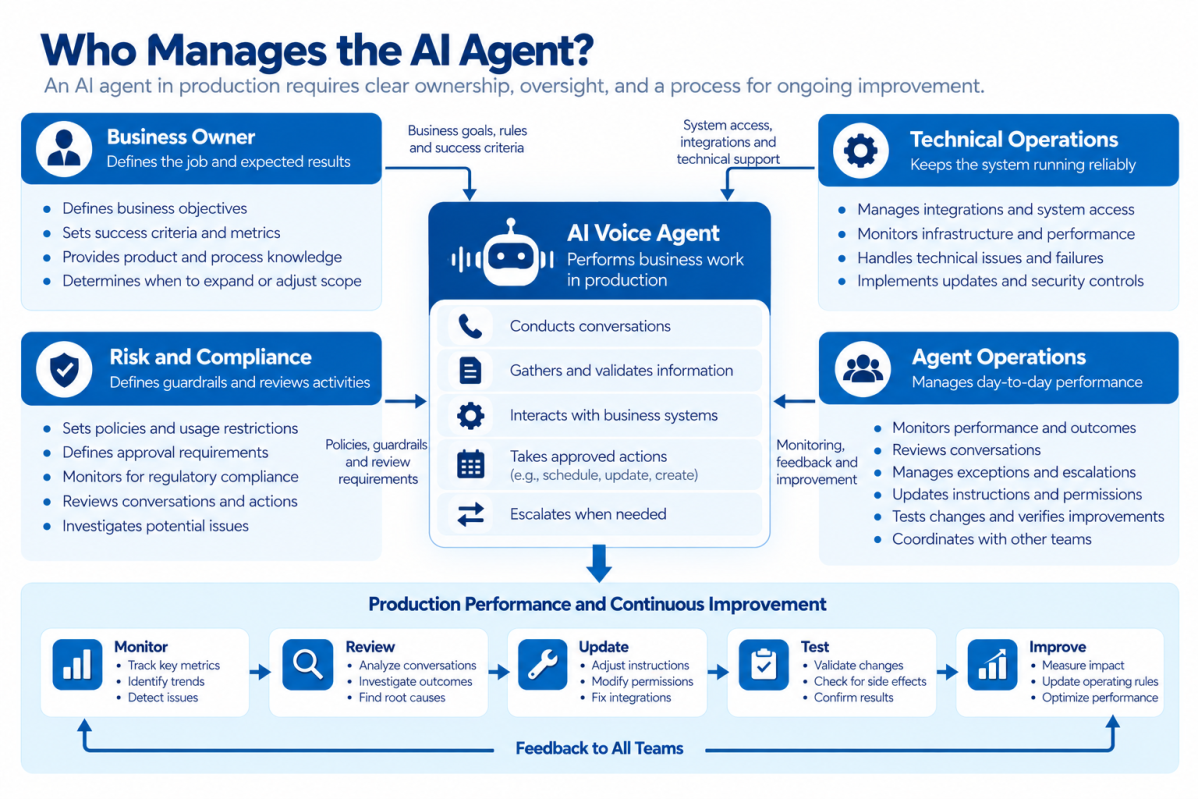
Consider a sales qualification agent. The sales or revenue operations team should define a qualified lead and decide whether the agent’s results meet business expectations. IT should own system access, integration health, and technical reliability. Security and compliance specialists should define and review appropriate restrictions.
These teams bring different expertise. Someone still needs to coordinate the operational response when performance drops or requirements change.
Three responsibilities need clear ownership:
- Business ownership: Is the agent doing the right work? Is the work useful?
- Technical ownership: Is the system reliable, secure, and behaving as intended?
- Operational management: Are problems identified, decisions made, and corrective actions completed?
One team or person may cover more than one responsibility. For a low-risk agent, a single owner with IT support may be enough. An agent taking consequential actions across multiple business systems needs stronger oversight and clearer approval boundaries. The level of management should match the agent’s responsibilities and the risks involved.
Measure Results, Not Just Conversations
The article on why AI voice projects fail made the case for looking beyond the AI model itself. Managing an agent takes the same discipline after deployment.
For an outbound sales agent, the number of conversations is a poor measure of success. Managers should track qualified leads, accurate CRM updates, appointments booked, and cost per successful outcome.
Useful measures for a customer service agent include successful resolution, repeat contacts, correct escalation, and customer satisfaction.
Technical measures still matter. Latency, failed tool calls, and integration errors help explain deteriorating results. Business metrics show whether the agent is delivering value. The manager needs both views.
When performance changes, someone needs to find out why, decide what to do, and verify that the intervention worked.
This also connects to Can Your Voice Agent Be Trusted With Your Business?. Trust requires more than appropriate rules at launch. Business requirements and systems change, so organizations need evidence that the agent continues to follow those rules.
Include Management in the Deployment Plan
Ask these five questions before launching an AI agent:
- Who owns the agent’s business results, and who is responsible for its day-to-day operation?
- Who reviews conversations, performance metrics, and unusual outcomes, and how often?
- Who approves changes to instructions, permissions, integrations, and business rules?
- What happens when the agent fails, reaches its limits, or needs to escalate a case to a person?
- Who has authority to restrict, replace, or retire the agent if its performance or risk profile changes?
Deploying an AI agent is the beginning of managing a new operational resource. Companies that assign ownership from the start will have a clearer path from a working demonstration to dependable business performance.
Eric Klein is the Founder and COO of Cloudonix, a leading provider of AI-powered communications infrastructure and the creator of the AI-first Business Phone System. With more than two decades of experience in telecommunications, cloud communications, and emerging technologies, he has helped organizations navigate the intersection of innovation, operations, and regulatory compliance. Klein is a recognized industry thought leader who regularly writes and speaks on topics including AI communications, telecom regulation, fraud prevention, and the evolving role of intelligent voice technologies in modern business.Edited by
Erik Linask